How to Switch Off: 7 Small Breaks for Stress


You close the laptop. Your brain does not.
It is 9:40 p.m. You are standing in the kitchen, technically off duty, and somehow still writing an email in your head. The dishwasher is humming. Your phone is face down, which feels very disciplined, except you have checked it twice in the last four minutes.
If you have ever searched for how to switch off at an hour when you should already be asleep, this post is for you. It is about small breaks for stress: simple ways to interrupt that feeling of always being on. Some take a minute or two; others deserve a little more time. All of them fit into ordinary life, somewhere between the laundry and the three unanswered emails.
You don’t need a silent retreat or a new life. Just seven ordinary things to try.
What you’ll find in this article:
why switching off feels so hard when you are used to being “on”
seven small pauses for sleep, movement, food, nature, silence, connection and play
one tiny thing to try today
what to do when the pause feels strange
Why it is so hard to switch off
For over a decade I worked in high-level leadership. I was used to doing several things at once, and honestly, I was good at it. My days were planned hour by hour. Even my weekends came with a quiet expectation: they had to deliver something.
So when I took a career break and finally had time, I assumed rest would simply arrive. Like a parcel.
It did not.
My calendar was empty, but my head kept running meetings. I would sit down with a cup of tea and immediately think of four things I could be doing instead.
I had spent years getting good at keeping busy. I was much less practiced at stopping.
If that sounds familiar, there is a reason. When your days are full of noise, open tabs and notifications, you get used to having something to respond to. Quiet can feel strange by comparison, as though you have forgotten an appointment. I wrote more about that in why you might not be lazy at all, just overstimulated.
And then there is guilt. That small voice that says a pause has to be earned. If that voice lives with you too, I explored where it comes from in why we feel guilty when we rest.
Here is what I learned slowly: switching off rarely happens all at once. I had to stop treating every spare minute as a gap to fill. A few minutes here, a different choice there. Nothing dramatic.
Small breaks for stress: pauses for your body
Some of the best pauses happen far away from your thoughts. They happen in your feet, on your plate and on your pillow.
1. Sleep: dim the lights and pick up paper
I used to “relax” in bed with my phone. Five minutes of news, ten minutes of messages, and then a long, mysterious hour in which I learned a lot about other people’s kitchens.
There is a reason that bedtime scrolling can work against a good night’s sleep. In one study, people who spent several hours reading on a glowing e-reader before bed took longer to fall asleep, had less REM sleep and felt less alert the next morning than those reading a printed book. That is not the same as checking your phone for five minutes, of course. But it does make the paper book look rather appealing.
A few extra minutes awake may not sound like much. Less so when you are already tired the next morning.
So here is the pause: thirty minutes before bed, dim the lights and swap the screen for a paper book. Any book counts. A crime novel, a cookbook, an old magazine. And if thirty minutes feels impossible tonight, try five. This is not a test to pass.
2. Movement: walk with an open question
For years my walks were a moving office. A podcast in my ears, Berni, my dog, pulling ahead, my brain quietly fixing a work problem.
A Stanford study found that people came up with around 60% more ideas on a creative-thinking task while walking than while sitting. It even worked on a treadmill in a plain room. So you really do not need a spectacular view.
The pause is simple: take a walk with one open question and don’t chase the answer. Think about it once, then let it be. The walk doesn’t have to become a problem-solving session.
There were so many walks I don’t remember at all. My body was outside with Berni. My head was in a meeting, in a problem, in next month. I was solving work problems and life problems, and I couldn’t see much light at the end of any of them.
One walk didn’t fix any of that. But one evening I stopped and actually looked at him.
He was doing exactly one thing. Sniffing. Slowly, thoroughly, as if this patch of grass was the most important document he would read all week. He wasn’t in the past or in the future. He was here, on this walk, with me, and he was clearly delighted about it.
For me, a walk had become another challenge. Steps to collect. Kilometers to log. Something to complete.
For Berni, it was the whole point. His only problem in that moment was which dog had peed on this lamppost before him.
I was everywhere except where I was. He was nowhere else.
3. Nourishment: one new plant
This one sounds like it belongs on a nutrition blog. Stay with me.
I like the idea of trying thirty different plants in a week. I don’t see it as a health challenge. For me, it is a reason to pay attention to what I eat. What could I add to lunch today that wasn’t there yesterday? It is a much more interesting question than what I should cut out.
Thirty sounds like a lot. Then you start counting: a handful of walnuts, some parsley, a lentil soup, the apple that has been looking at you from the fruit bowl since Monday.
The pause: add one new plant to a meal today and aim for thirty a week, if you enjoy the idea. Put your phone down for the first few bites. The point is to make a rushed lunch a little more interesting. There is no score to keep.
Pauses for a mind that never stops
4. Nature: twenty minutes, no soundtrack
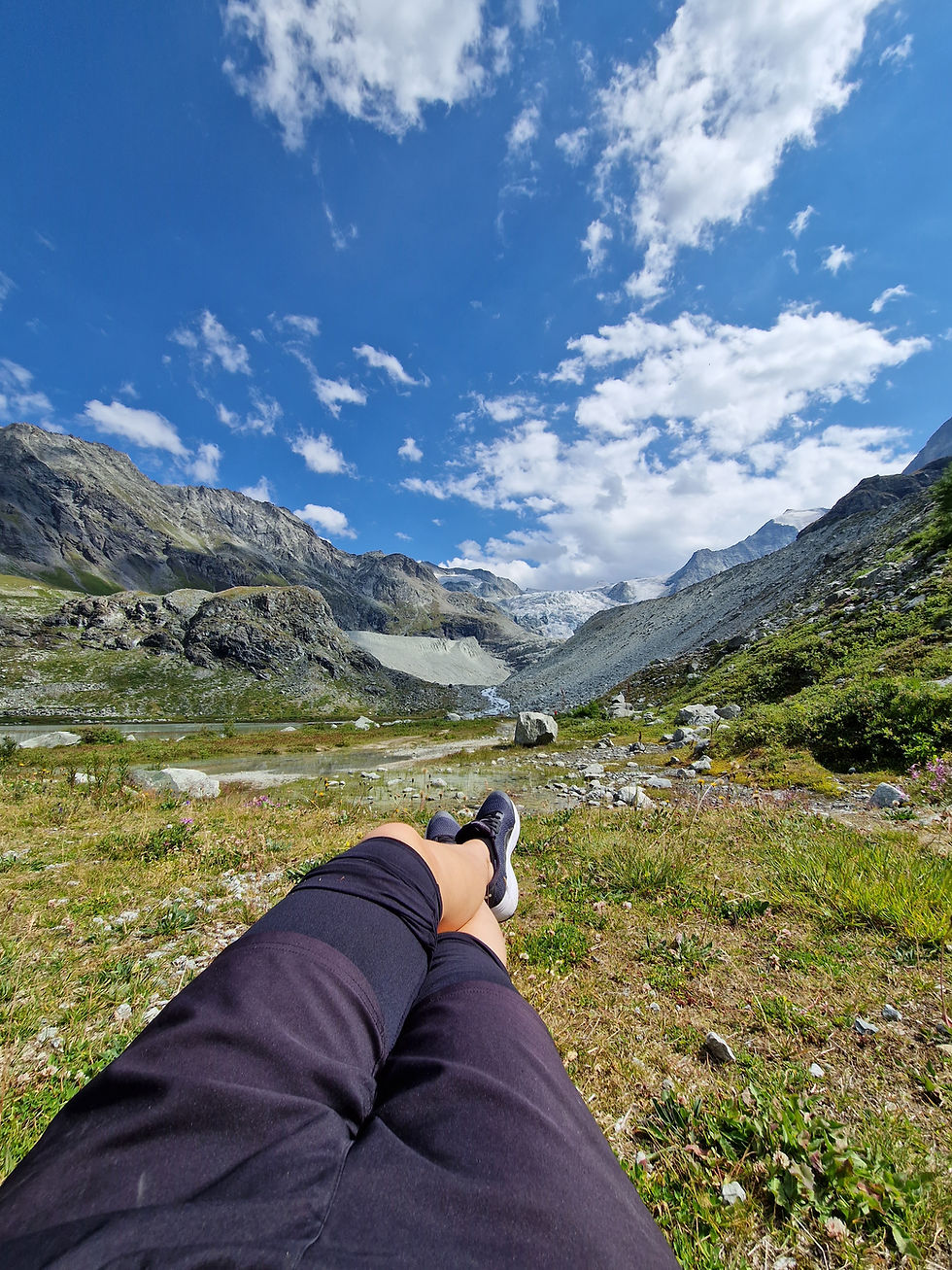
I love the Alps. Oberstdorf, Sulzfluh, long days with heavy legs and huge views. But the nature pause I need most is much smaller than a summit.
Researchers who followed people spending time outdoors found that around twenty to thirty minutes in a place that felt like nature was linked with lower cortisol levels, one marker of stress. It is not a guarantee of instant calm, but I like that the setting did not have to be somewhere spectacular.
A place that felt like nature. That can be a mountain. It can also be a park, or a quiet street with old trees.
The pause: go outside for twenty minutes with no music, no podcast and no goal. This was the hardest one for me. Walking without a podcast felt almost rude, as if I was wasting perfectly good minutes. Then I started noticing things. The wind. The smell after rain. And if you only have three minutes today, take those three.
5. Stillness: two minutes longer than comfortable
Here is a study that made me laugh and then feel slightly seen.
In one small experiment, people were asked to sit alone with their thoughts for fifteen minutes. They were also given the option of administering a mild electric shock to themselves. Quite a few chose the shock. I still find that astonishing.
So if silence feels uncomfortable, you are in good company. Silence takes practice.
The pause: stay in silence two minutes longer than feels comfortable. Just two, if the discomfort is mild. When you feel the urge to reach for your phone, notice it. Then stay a little longer. You do not have to force it if it becomes genuinely distressing.
If you like the idea of doing nothing on purpose, I wrote more about it in Strategic Laziness: the art of doing nothing.
6. Connection: the coffee chat
When I was always on, buying coffee was a transaction. Card, cup, gone. Ideally while reading an email.
A smile, a question, a few words while you wait for your coffee. It sounds almost too ordinary to matter. But I used to move through those moments as though talking to another person were an unnecessary delay. Faster was better. Less conversation, more efficiency.
Simply efficient. That was basically my job description.
The pause: when you buy your coffee, smile, make eye contact and have a short chat. Thirty seconds about the weather is enough. It reminds you that there are real people outside your inbox.
7. Play: three good things
Play can mean via ferrata or singletrack, and I would never say no to either. Writing a list is not exactly play. But noticing what you enjoyed, rather than only what you managed to finish, is a good place to start.
It is surprisingly easy to remember what went wrong and forget the smaller things that were actually good. An annoying email can stay with you all evening. A funny conversation disappears from memory by dinner. I like this pause because it asks a different question about the day.
The pause: write down three good things from today. They can be very small. Warm socks. A green light at the right moment. A message that made you smile. This is not about pretending a difficult day was wonderful.
Try one today
You do not need all seven. Please do not turn this list into a new project with color coding. I have been very good at doing exactly that.
Pick one pause for today. Just one. Here is the easiest way to start:
Choose the moment first: after lunch, on the way home, or just before bed.
Start with two minutes. If you have chosen a longer pause, give it more time when you can. Phone face down, or better, in another room.
Do only the pause. One thing at a time.
Afterwards, notice one small change in your body. Shoulders, breath, jaw. Anything.
Tomorrow, try it again. Or choose a different one. You are not building another checklist.
When the pause feels strange
A small warning, because I wish someone had given it to me.
The first pauses may feel restless. A bit flat. Even a little empty.
That is normal. Often it simply means you have been running for a long time, and the quiet finally has room to show you how tired you are. I wrote about that feeling in why you feel empty when you finally slow down.
Be patient with yourself here. Your calendar can change in a day. Your habits may take longer to catch up.
You do not have to become a different person to learn how to switch off. A few minutes a day that belong only to you are enough to start.
If choosing feels like one decision too many, start with The Daily Pause at Pause to Play. There is a new free pause every day. Try today’s, and let that be enough.


Comments