Embracing the Pause: You’re Not Lazy, You’re Overstimulated

The Myth of Laziness in an “Always-On” Era
You’re sitting in front of your laptop. The cursor blinks rhythmically, counting down your inactivity. An important project awaits. Maybe you need to plan a trekking route in the Alps or tackle overdue invoices. Instead, you find yourself mindlessly scrolling through Instagram. An hour slips by, and guilt grows with every inch of the screen you slide past.
Your internal critic kicks in with a harsh voice: "Come on, move it. You’re lazy. Others are building empires right now, and you can’t even reply to three emails."
But what if I told you that’s a lie? What if the problem isn’t your lack of discipline? What if your operating system has simply overheated?

The Science Behind the Fog
Through over a decade in high-level leadership, I learned how to optimize processes, deliver results under pressure, and manage team energy. But the most important lesson I learned wasn't in the office. It was the moment I felt my own "engine" burning out. I realized then that laziness, in the sense we were taught in school, barely exists.
What we call laziness is often the body’s defense mechanism. In a world that constantly demands our attention—through notifications, news, social expectations, and never-ending to-do lists—our brains live in a state of permanent alarm.
When you feel like you "don’t want to do anything," it’s usually not a lack of ambition. It’s decision fatigue and cognitive overload. You are overstimulated. Your brain doesn't need more motivation or another time management course. It needs a radical cut-off from incoming stimuli.
You’re not lazy; you’re overstimulated. Once you understand that your lack of focus is a response to constant mental input—not a personal failure—the guilt begins to dissolve.
The Science Behind the Fog: What Does Neurobiology Say?
The phenomenon we colloquially call "overstimulation-induced laziness" has a deep scientific basis. You aren't to blame—you are simply a biological system that has encountered a critical error.

1. Exhaustion of Prefrontal Cortex Resources
The prefrontal cortex is your brain’s "CEO." It’s responsible for logic, planning, and—most importantly—willpower. Research by Dr. Roy Baumeister on ego depletion suggests that our capacity for self-control is a finite resource. Every notification, every micro-decision (should I click this link?), consumes glucose and energy from your prefrontal cortex. When resources run low, the brain switches to "power-saving mode," which we interpret as a lack of desire to act.
2. Overstimulation and the Dopaminergic System
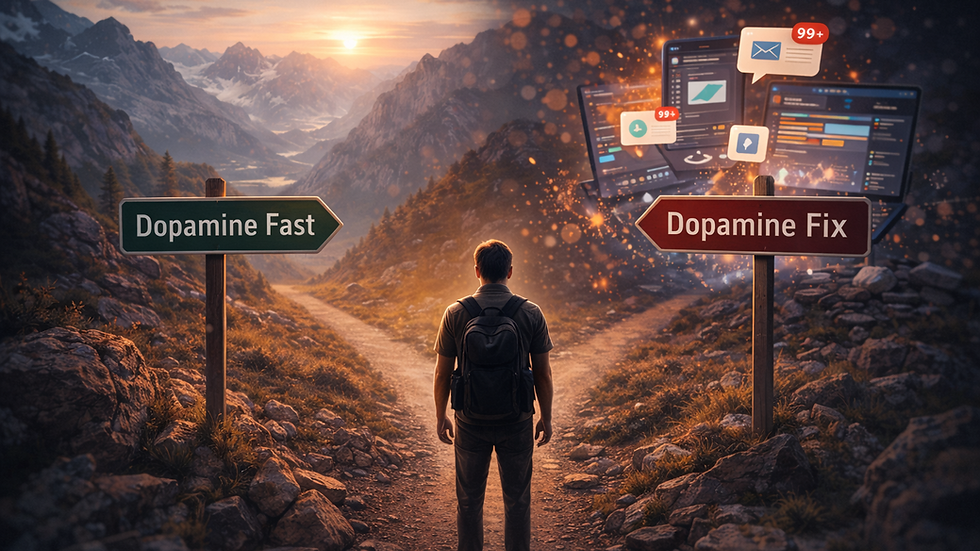
Modern technology bombards us with high-intensity stimuli. Every "like" or red notification dot triggers a dopamine hit. The problem is that when dopamine receptors are constantly stimulated, they become less sensitive (downregulation). As a result, standard tasks (like writing a report or planning) feel boring and painful because they don't provide the same quick dopamine spike as scrolling social media.
3. The Default Mode Network (DMN)
When you’re doing nothing, your brain isn't actually asleep. It activates the Default Mode Network. Neurobiological studies (including those by Dr. Marcus Raichle) show that the DMN is crucial for creativity, emotional processing, and building a sense of identity. If you never give yourself time for "boredom," your DMN never gets a chance to organize the data. The result? Chaos in your head and a feeling of being overwhelmed.
Why Do We Mistake Fatigue for Laziness?
Our culture has built a cult of "hustle"—the belief that every minute must be productive. When we stop producing, we feel existential anxiety. However, overstimulation is a physiological state, not a character flaw. Here is how to recognize it:
Decision Fatigue: Choosing the color of your socks or what to have for lunch feels like an insurmountable task. Your "decision pool" for the day has been drained by hundreds of micro-stimuli (emails, notifications, ads).
Escaping into "Cheap Dopamine": It’s a paradox—you feel you don’t have the energy for work, but you have the energy for 2 hours of TikTok. Why? Because your brain is desperately seeking a low-effort, high-speed reward. This isn't relaxation; it’s "numbing."
Brain Fog: You feel as if you’re looking at the world through a dirty window. Thoughts move slowly, and you can’t connect the dots that you usually link in seconds.
The Pause Strategy: How to Reclaim Space?
In the Pause to Play philosophy, we believe that a pause is not a luxury—it’s a strategic element of high performance and a happy life. If you feel stuck, don’t fight yourself. Change your environment.
1. Radical Micro-Pauses (The 15-Minute Reset)
Leave your phone in another room. Turn off notifications on your watch. Sit in a chair and do nothing. Don’t listen to a podcast, don’t read a "personal growth" book. Let your thoughts settle like sediment at the bottom of a glass of water. It is in this silence that the best ideas are born, not in the noise of "productivity."
2. Body & Soul: Aimless Movement
On "My Path," I discovered that mountains are the best medicine for overstimulation, but we don’t always have the Alps at hand. Walk to the nearest park, but leave your phone in your pocket. Don’t count your steps; don’t measure your pace. Just walk.
The Scientific Proof: Attention Restoration Theory (ART), developed by Rachel and Stephen Kaplan, suggests that spending time in nature allows the brain to regenerate its directed attention resources. Nature offers "soft" stimuli (rustling leaves, clouds) that don't exhaust the brain, unlike the "hard" stimuli of urban and digital life. This is the same principle behind forest bathing, or shinrin-yoku: a slow, sensory way of being in nature that helps your mind recover without turning rest into another task.
3. The Power of One
Instead of fighting a list of 10 tasks that only deepens your stress, do something counterintuitive: cross out 9 of them. Pick one thing. The smallest one. Do it, and give yourself permission to rest for the remainder of the day. Often, taking that one step unlocks the energy for more, but if it doesn't—that’s okay too.

From Pause to Play - You’re Not Lazy. You’re Overstimulated
When we strip away the "lazy" label, the tension disappears. And where there is no tension, there is room for creativity and the joy of action (Play). Only when your head rests from the digital and social noise will you regain your appetite for real adventures—on the trail, in business, and in relationships.
Remember: Your value is not determined by the number of checked boxes in your calendar. Sometimes, the bravest and most "leader-like" decision you can make is to consciously withdraw for a moment to come back stronger.
Pause. Breathe. Return to the game on your own terms.
You may also like:


Comments